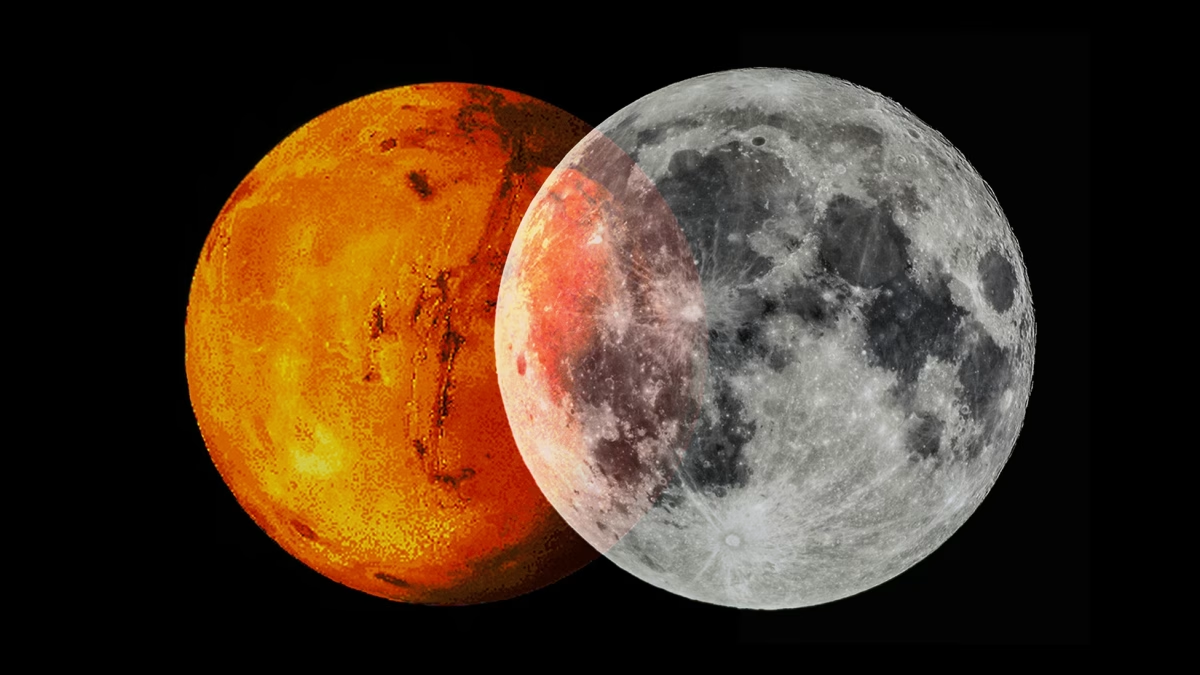
Mars: the enigma of possible life outside of Earth. For years, scientists have been fascinated by the possibility of life on the Red Planet, but due to the great distance between Earth and Mars, it is difficult to go to the planet itself and collect certified samples that solves this mystery. But, with the Artemis missions and the recent Artemis II mission, that could be very possible in the near future.
On April 1, 2026, astronauts Reid Wiseman, Victor Glover, Christina Koch, and Jeremy Hansen set off on a journey around the Moon and back—the farthest humans have traveled in space. The mission spanned a total of ten days, reaching the Moon by the sixth and returning home by the tenth.
The mission—in a nutshell—was one massive test. A prerun of crucial systems needed for the chances of deep space travel.
“Four Artemis II astronauts are flying aboard NASA’s Orion spacecraft around the Moon and back, as they test how the spacecraft’s systems operate in deep space,” NASA said.
But it is not just as simple as testing out the technology that will allow spacecrafts to travel into space. But also, a way to see how the body will respond and handle the conditions of deep space.
Due to the lack of gravity, which plays a major role in the strength of bones, astronauts lose about 1% of their bone mass per month. Not to mention, considering the fact it takes six to nine months to get to Mars—the grand goal of the Artemis missions—from Earth, this can lead to some major complications during their time in space. And that is only factoring in the trip there.
“On one hand, weightlessness is known to induce a weakening of the immune system, delayed wound healing, and musculoskeletal, cardiovascular and sensorimotor deconditioning,” an article by National Library of Medicine said.
Cosmic radiation is another major factor that can make deep space travel life threatening. As without the protection of Earth’s atmosphere or magnetosphere, astronauts are exposed to high-energy particles in space that can lead to long-term health issues.
“On the other hand, radiation exposure can lead to long-term health effects such as cancer and cataracts as well as have an adverse effect on the central nervous and cardiovascular system,” it also says in the previous article mentioned.
This is part of the reason why Artemis II went no further than the Moon. A good way for NASA to dip their toes in the water of deep space without putting the astronauts at too much health risk.
Speaking of the Moon, being that it has been nearly 54 years since the last time humans have ventured to Earth’s natural satellite, Artemis II is a great way to reopen the lunar industry and build an economy. Which would prompt private companies to invest in it and raise the chances of more frequent and cheaper space travel for space agencies.
“NASA has said its moon strategy stimulates the commercial space industry and creates business opportunities in ways that could foster a lunar economy,” Live Science wrote in an article.
Referring back to how long it has been since humans last went to the Moon, with the clean execution of Artemis II—and how accessible and quick news is—this could reach and inspire more people to go into STEM fields. Increasing the success rate of future space missions if more people take part in the science and technology behind it.
In short, while there are some concerns and precautions around space technology and human health, with the success of the Artemis II and the hope for success of future missions already set in stone. It is safe to say that it will only be a matter of time before mankind sets another historical record and steps foot on Mars. Along with the chance to fully uncover the history and chances of possible life on the Red Planet.